

TL;DR:
- NFC cards are replacing paper ones, offering fast, up-to-date, and sustainable networking.
- They are better for the environment and more cost-effective in the long run.
- NFC adoption in Greece is growing, especially in professional meetings and events.
Every year, 7 billion paper cards are produced globally, and 88% of them end up in the trash within a week. This isn't just a waste of paper; it’s a waste of time, money, and professional opportunity. In 2026, Greek professionals and entrepreneurs face a clear question: stick with traditional paper cards or switch to NFC solutions? In this article, you will find a comparison, benefits, costs, and practical tips to help you make the best decision for your networking.
Table of contents
- What are NFC cards and how do they work
- Comparison of NFC cards vs. traditional cards
- NFC benefits for Greek professionals and businesses
- Environmental friendliness and cost of use: Which solution really wins?
- Why professional meetings in 2026 no longer have room for paper cards
- How to take the next step in your networking with an NFC card
- Frequently Asked Questions
Key Takeaways
| Point | Details |
|---|---|
| Exchange speed | NFC offers instant data exchange without typing, improving networking. |
| Environmental benefit | Using an NFC card drastically reduces waste compared to traditional ones. |
| Modern image | An NFC card upgrades your personal brand and connects directly to digital media. |
| Long-term economy | Despite the initial cost, NFC provides greater value through its lifespan and updates. |
What are NFC cards and how do they work
Now that we’ve outlined the dilemma, let's look at exactly what NFC cards are and why they upgrade networking.
NFC (Near Field Communication) cards are business cards that contain an embedded electronic chip. This chip communicates wirelessly with a smartphone from a distance of a few centimeters. Using them is simple: you bring the card near your contact's phone, and your digital profile opens automatically in less than a second.
The digital profile is the heart of the solution. There, you can store your contact details, social media, your website, your portfolio, and any other information you want to share. Crucially, you can update this information at any time without needing to print new cards.
NFC cards use an embedded chip for instant data exchange, connecting to dynamic digital profiles that update in real time. This means if you change jobs, phone numbers, or email addresses, your card remains current at no extra cost.
Key features of an NFC card include:
- Tap-to-share functionality: One tap is all it takes to share all your details.
- Dynamic digital profile: Updates online without replacing the physical card.
- Multiple information types: Contacts, social media, website, videos, portfolio.
- No app required for the recipient: The person you’re meeting doesn’t need to download anything.
- Analytics: You can see how many times your profile has been scanned.
Furthermore, replacing paper cards with NFC solutions doesn't require technical knowledge. Setup is simple and management is handled via an online dashboard.
Pro tip: Most modern smartphones (Android since 2015 and iPhone from iPhone 7 onwards) support NFC. If you're unsure, check your phone’s settings under "Connectivity" or "Wireless." For older models, the recipient can scan a QR code that comes with the card.
Comparison of NFC cards vs. traditional cards
After defining and explaining how NFC works, let's look at them side-by-side with traditional solutions.
NFC takes less than 1 second for data exchange, while a paper card requires manual entry by the recipient, with all the potential for errors that entails. This difference in speed is not small. At a networking event with dozens of contacts, the difference becomes very noticeable.
| Criteria | NFC card | Paper card |
|---|---|---|
| Exchange speed | Under 1 second | 1-3 minutes (manual entry) |
| Information updates | Instant, online | New printing required |
| Cost per use | Zero after purchase | Continuous printing costs |
| Environmental footprint | Minimal | High (paper, ink, transport) |
| Information shared | Unlimited (digital profile) | Limited (card space) |
| Analytics | Yes (views, clicks) | No |
| Professional image | Modern | Traditional |
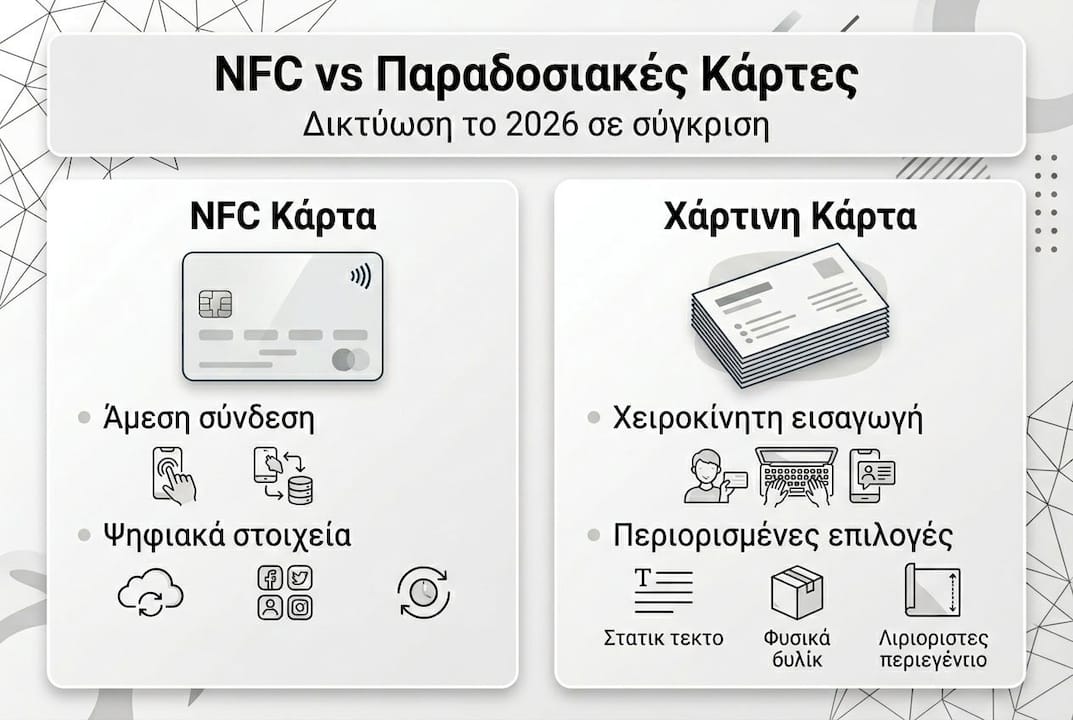
For a detailed analysis of the differences between NFC and paper cards, there are many elements worth considering before deciding.
NFC card advantages:
- Instant data transfer without typing errors
- Ability to update without new printing
- Unlimited information in the digital profile
- Analytics data for every contact
- Zero reproduction costs
NFC card disadvantages:
- Higher initial investment
- Requires an NFC-enabled smartphone for full functionality
- Less familiar to some age groups
Paper card advantages:
- Low initial cost
- Works without technology
- Familiar and accepted everywhere
Paper card disadvantages:
- 88% are thrown away within a week
- Not easily updated
- Limited information space
- Continuous printing costs
Statistic: Globally, businesses spend billions of euros every year on paper cards that, in the vast majority of cases, lead to no professional contact.
NFC benefits for Greek professionals and businesses
Now that we've looked at the objective benefits, let’s examine what NFC solutions mean in practice for the Greek market.
In Greece, professionals are adopting NFC through providers like ilo and artificialsystem.eu, gaining analytical tracking data that helps them understand which contacts are interacting with their profile. This is something a paper card is completely unable to offer.
The future of NFC networking in Greece is on an upward trend, as more and more companies and freelancers look for ways to stand out in a competitive environment. The benefits of NFC in networking aren't just about technology, but also about the image the professional projects.
The most popular ways to use NFC cards in Greece:
- Networking events and conferences: Fast data exchange with many people in a short amount of time.
- Client visits: Instant saving of details to the client's CRM via the digital profile.
- Exhibitions and trade shows: Presentation of portfolios and products with one tap.
- Restaurants and shops: Link to Google Reviews, menus, or online booking.
- Freelancers: Presentation of services, price lists, and contact info in one profile.
| Sector | NFC usage method | Main benefit |
|---|---|---|
| Finance | Exchanging details at meetings | Speed and accuracy |
| Real estate | Connecting to properties and portfolio | Complete presentation |
| Technology | Connecting to GitHub, LinkedIn | Professional image |
| Retail | Connecting to an e-shop | Increased sales |
The transformation of networking through NFC is particularly visible in professional meetings. Instead of digging into your pockets for a card that you might not even have with you, NFC is always available. Additionally, there are seven reasons for NFC cards that make a difference in today's professional scene.

Pro tip: Link your NFC profile to your LinkedIn, your website, and a link for direct communication (e.g., WhatsApp or Calendly). This way, your contact has all the tools to reach out immediately after the meeting, without delay.
Environmental friendliness and cost of use: Which solution really wins?
Having seen the benefits for you and your business, let's examine the environmental dimension and cost.
The numbers speak for themselves. Seven billion paper cards are produced annually worldwide. Their production requires water, energy, chemicals, and paper. And 88% of them lead to no professional contact. They just end up in the trash.
NFC significantly reduces waste, as one card is used for a lifetime, while paper ones end up immediately in the trash. This isn't just an environmental argument; it is also an economic one.
“One NFC card replaces hundreds of paper cards during your professional life. The environmental and economic benefit is immediate and measurable.”
Environmental advantages of NFC:
- Zero ongoing paper production
- No chemical printing inks
- No packaging and transport for reorders
- One card for the entire duration of use
Environmental disadvantages of paper cards:
- Constant consumption of paper and ink
- Transport footprint for every new order
- Disposal in the vast majority of cases
Regarding cost, the initial investment for an NFC card is higher than for a paper one. However, if you calculate the cost of printing paper cards over 2-3 years, including every update of details, NFC proves to be a more cost-effective solution in the long run. A freelancer who orders 500 cards every year spends significantly more than they would on a single NFC card that never needs replacement.
Why professional meetings in 2026 no longer have room for paper cards
After objective and numerical analyses, let's look at the real essence behind professional meetings today.
There is a prejudice we often hear: "The paper card has a personal touch." That may have been true once. In 2026, however, a paper card does not convey a personal touch; it conveys an outdated image.
Professionals who insist on paper cards face a real risk: appearing anachronistic in an environment where technology is a given. Your contact, especially if they are younger or in a tech field, will notice this difference. The real change in networking is not just technological; it’s about perception and image.
NFC doesn't make networking impersonal. On the contrary, it allows the professional to share more: videos, portfolios, customer reviews, and even a short biography. The first impression becomes richer, not poorer. And the biggest risk for those who insist on paper? Losing contacts who simply won't bother to type in their details manually.
How to take the next step in your networking with an NFC card
Transitioning to NFC is easier than you think. See how you can get started today.
TagTouch offers NFC cards for every professional need. Each card connects to a customizable digital profile that is easily updated online.

Available options:
- Mirror NFC Card: Card with a mirrored surface. Ideal for a modern, impressive look.
- White NFC PVC Card: Classic PVC card in white. Functional and professional.
- Black NFC Metal Card: Metal card in black. Premium look for high professional standards.
Choose the type that fits your image and start networking more effectively today.
Frequently Asked Questions
Are NFC cards compatible with all smartphones?
NFC cards work with smartphones that have NFC technology, i.e., most modern Android models and iPhones from the iPhone 7 onwards. Older devices without NFC can use the QR code that usually comes with the card.
How secure is the use of an NFC card for my professional details?
NFC requires direct contact and owner authorization, so data transfer only occurs when you choose to initiate it. The owner always decides which information is visible on their digital profile.
Is an NFC card a reliable replacement for paper business cards?
Major companies are now adopting NFC cards for a modern image and sustainability. For networking in Greece in 2026, NFC cards clearly provide more benefits in terms of speed, updates, and professional image compared to paper cards.
How much does an NFC card cost compared to traditional ones?
The NFC card has a higher initial price, but zero reproduction costs. In the long run, NFC often proves to be a more cost-effective choice than recurring orders of paper cards.