

Many professionals believe that NFC and QR codes are simply different names for the same technology. In reality, these two methods of sharing information work in completely different ways and offer distinct advantages. By understanding their fundamental differences, you can choose the right tool for networking and your professional presence. This article will analyze the key features, advantages, and limitations of each technology so that you can make informed decisions for your business.
Table of contents
- Key points on the differences between NFC and QR codes
- What is NFC and how does it work
- What is a QR code and how does it work
- Key differences between NFC and QR codes
- How to choose between NFC and QR codes for your business
- Explore TagTouch digital business cards with NFC
- Frequently asked questions about NFC and QR code differences
Key Takeaways
| Point | Details |
|---|---|
| Instant NFC connection | NFC technology allows for an instant connection without additional user actions. |
| Visual QR code | QR codes are scanned by any mobile camera and lead directly to the relevant information without an extra app. |
| Different user experience | NFC offers a fast and direct experience without scanning or typing, while QR requires scanning and potential data entry. |
| NFC requirements | NFC requires the feature to be enabled in settings and compatibility between devices. |
What is NFC and how does it work
NFC (Near Field Communication) is a wireless communication technology that enables data exchange at a distance of up to 4cm. It is based on electromagnetic induction between two devices located in close proximity. When you bring an NFC card near a compatible smartphone, a wireless connection is automatically established that transfers information without the need for an app or manual input.
NFC technology uses radio frequencies to transmit data with exceptional speed and accuracy. In professional networking, this means you can share your digital profile with a simple tap. The recipient does not need to download an app or type anything. The connection is made automatically, leading directly to the page with your contact information.
The key benefits of NFC for professionals include:
- Instant connection with no intermediate steps
- Extremely fast data transfer
- Discreet and professional experience
- Does not require line-of-sight or specific angles
- Works even in low light
Professional tip: When using NFC phone tags or cards, make sure the recipient's smartphone has NFC enabled in its settings. Most modern Androids and iPhones (from model XS onwards) support the technology without the need for additional apps.
The use of NFC on business cards fundamentally changes how professionals network. Instead of exchanging paper cards that are often lost or forgotten, you offer an instant digital connection that is automatically saved to the recipient's device. This ensures your details remain accessible and up-to-date.
What is a QR code and how does it work
A QR code (Quick Response code) is a visual code scanned with a camera to access digital information. It consists of black squares arranged on a white background and can store URLs, text, contact details, and other data. To use it, you open your smartphone's camera app and point it at the code.
The operation of a QR code is based on visual pattern recognition. When the camera detects the code, the phone's operating system automatically recognizes the encoded information and suggests an action, usually opening a link. The process is simple but requires a steady hand and proper lighting for accurate focusing.

The QR code has become extremely popular due to its universal compatibility. Every smartphone with a camera can scan a code without special hardware. This makes it ideal for broad distribution in advertising material, posters, product packaging, and marketing collateral.
The main advantages of a QR code include:
- Universal compatibility with all smartphones
- Low production and printing costs
- Ability to be printed on any material
- Easy integration into digital and print media
- Does not require special equipment from the user
Professional tip: For best results with QR codes, use high resolution and leave sufficient white space around the code. This facilitates scanning even under poor lighting conditions. Also, always test the code with different devices before distributing it.
In professional use, the QR code serves well in scenarios where you want to provide access to information for a large audience. You can place it on business cards, presentations, brochures, and even on digital screens. Its flexibility makes it a versatile, multi-purpose tool.
Key differences between NFC and QR codes
The fundamental difference between the two technologies lies in how they operate. NFC requires physical proximity and compatible devices, while a QR code uses visual scanning that works with every smartphone. This technical difference directly affects the user experience and the suitability for different professional scenarios.
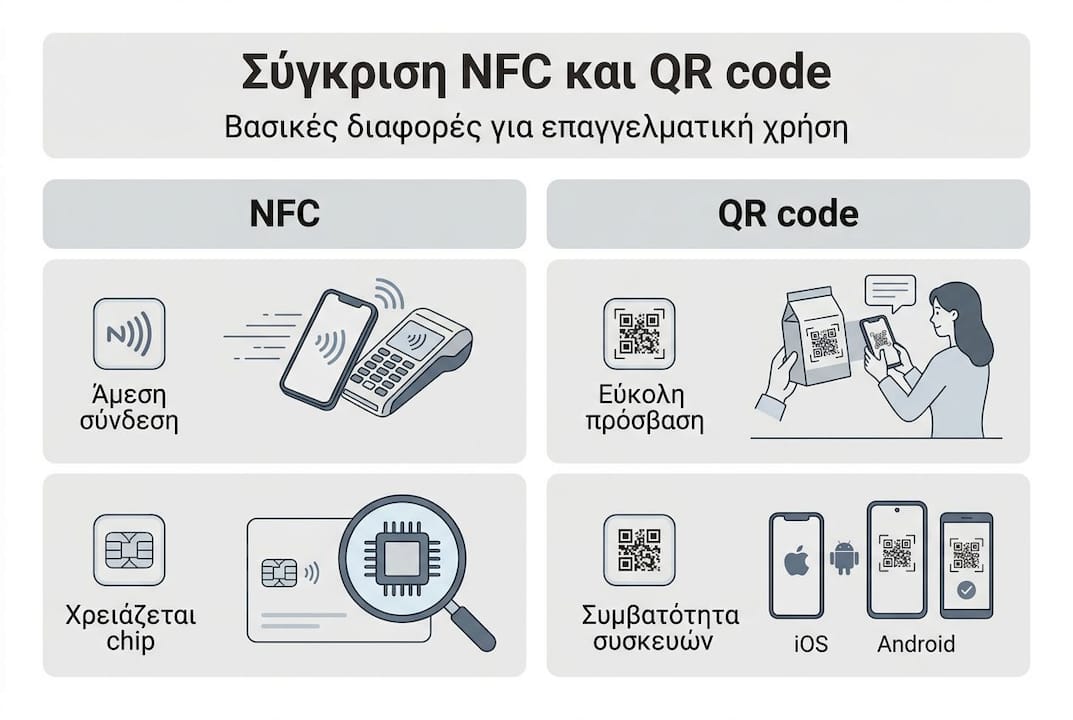
In terms of speed, NFC offers an instant connection. You simply bring the card near the phone and the data transfer is completed in a fraction of a second. A QR code requires opening the camera, focusing on the code, waiting for recognition, and then tapping the link that appears. These extra steps may seem minor, but in a professional environment, immediate interaction makes a difference.
| Criteria | NFC | QR Code |
|---|---|---|
| Compatibility | Only devices with an NFC chip | All smartphones |
| Speed | Instant (< 1 second) | 3-5 seconds |
| Ease of use | Excellent (one tap) | Good (requires focusing) |
| Implementation cost | Higher (special cards) | Lower (printing) |
| Security | Higher (short range) | Lower (visually accessible) |
| Environmental constraints | Works everywhere | Requires good lighting |
Security is an important parameter. NFC has built-in protection due to its very short range. No one can read the data from a distance. In contrast, a QR code is visible to anyone and can be easily photographed or copied. This is not necessarily a disadvantage, but you should take it into account when sharing sensitive information.
Notable differences in practical use:
- NFC works even in total darkness, whereas a QR code needs sufficient lighting
- NFC is not affected by wear or dirt on the surface; a QR code can become unreadable
- NFC offers a more premium and technologically advanced impression
- A QR code can be printed in any size and on any material
In a professional context, the choice depends on the target audience and the usage environment. If you are networking at tech conferences or corporate events where attendees have modern smartphones, an NFC business card offers a superior experience. For a wider audience or print material, the QR code remains more accessible.
How to choose between NFC and QR codes for your business
The right choice of technology is based on practical criteria such as the environment and the ease of use for the target audience. Before deciding, you must carefully evaluate your business needs and how you will interact with clients and partners. Each technology serves different goals and scenarios.
-
Analyze the technological profile of your audience. If you are addressing a younger, tech-savvy audience that uses recent smartphone models, NFC offers the best experience. For a broader demographic, the QR code ensures universal access.
-
Consider the environment where the technology will be used. Indoors with controlled lighting, both options work flawlessly. Outdoors with bright sunlight or low light, NFC demonstrates more consistent performance.
-
Calculate your budget and distribution volume. QR codes have lower production costs and can be printed in large quantities economically. NFC requires an investment in special cards but offers a premium image that strengthens your brand.
-
Evaluate the importance of interaction speed. At networking events where time is limited, the instant connection of NFC allows for rapid data exchange with dozens of people. QR codes work better when people have time to scan comfortably.
-
Think about long-term maintenance and updates. Both technologies allow for dynamic content updates without changing the physical card, but NFC offers a more durable physical form that withstands wear.
-
Consider the possibility of combining both. Many digital business cards include both technologies, offering maximum flexibility. This ensures that no one is excluded from accessing your information.
-
Measure and evaluate the results. Both technologies allow for tracking interactions via analytics. Monitor which method leads to more connections and adjust your strategy accordingly.
The choice doesn't have to be exclusive. Many successful businesses use NFC for immediate networking at events and QR codes for print advertising material. This hybrid approach maximizes reach and effectiveness.
Explore TagTouch digital business cards with NFC
If you are looking for a modern solution for your professional networking, TagTouch offers a variety of high-quality NFC cards that combine technology with elegant design. With a simple tap, you share your full digital profile, including contact details, social media, your website, and your portfolio.
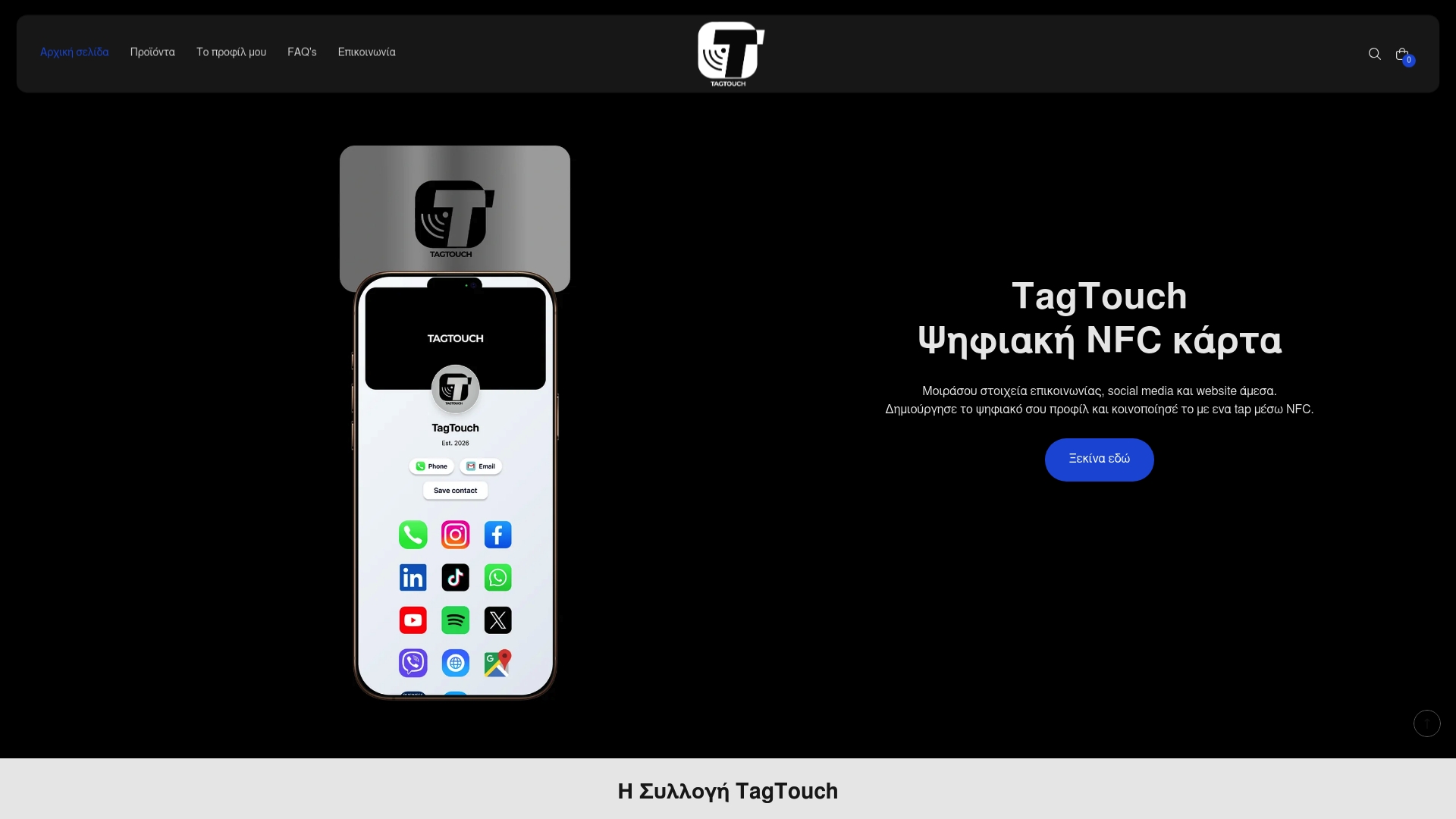
The Mirror NFC Card offers premium aesthetics with an elegant mirrored surface that impresses at every meeting. For a more classic approach, the White NFC PVC Card provides a clean, professional look that suits any brand. Each card is linked to a personalized digital profile that you can easily update at any time, ensuring that your information remains current. Learn more about the company and the technology we use on our About Us page.
Frequently asked questions about NFC and QR code differences
Which technology is safer for professional use?
NFC offers a higher level of security due to its very short range that requires physical proximity. No one can access the data from a distance or copy the card without physical contact. A QR code is visually accessible and can be photographed by anyone, but this is not a problem for public professional information.
Can a smartphone without NFC use an NFC card?
No, the device must have a built-in NFC chip to read NFC cards. Most modern Android smartphones and iPhones from model XS onwards support NFC. For devices without NFC, you can use the QR code that usually accompanies digital cards as an alternative access method.
How easy is it to update the information on an NFC digital card?
Updating is extremely simple and is done online via your dashboard. You change the details in your digital profile and the changes are applied instantly without needing to replace the physical card. This means that everyone who has received your card always sees the most recent information when they scan it.
What is required to scan a QR code correctly?
You only need a smartphone with a camera and sufficient lighting. Open your camera app, point it at the QR code from a distance of 10 to 20 centimeters, and wait for the notification with the link to appear. Ensure that the code is clean and without light reflections for better recognition.
Is it possible to combine NFC and QR codes on a business card?
Yes, many modern digital cards include both technologies. This offers maximum flexibility, allowing users with NFC to enjoy the instant connection, while those without NFC can use the QR code. This hybrid approach ensures that no one is excluded from accessing your information.
Recommended
- Step-by-step networking with NFC for professionals in 2026 – TagTouch
- What is an NFC Phone Tag? How it works and where it is used – TagTouch
- NFC Business Cards & Digital Profile | TagTouch
- 7 reasons to use the TagTouch NFC Business Card
- QR Codes on Business Cards: Elevating Luxury Beauty Brands – BcardsCreation