

TL;DR:
- NFC cards provide instant, error-free access to digital profiles and social media.
- Personalization, compatibility, and the use of a QR fallback are critical for effectiveness.
- NFC enhances professional branding, lending a modern, impressive character.
Business cards are not obsolete. What is obsolete is the way we use them. A piece of paper with a phone number and email is no longer enough to leave an impression in a professional space where everyone is looking to stand out. NFC (Near Field Communication) technology completely changes this image. With a simple tap, you transfer all your details, your profile, your social media, and your website, without needing any app. In this guide, you will see how to leverage NFC to build a modern and reliable professional brand.
Table of Contents
- Why NFC is a game-changer for professional branding
- Design and personalization of digital NFC cards
- Combining NFC and QR for accessibility and reliability
- Advanced practices, mistakes, and challenges with NFC cards
- Why NFC does not replace — but enhances — professional branding
- Get ready for the next level of branding with an NFC card
- Frequently Asked Questions
Key Takeaways
| Point | Details |
|---|---|
| NFC enhances branding | With impressive technology and direct interaction, NFC upgrades your image. |
| QR combination for everyone | By integrating a QR, you ensure that every contact sees your profile without restrictions. |
| Personalization and measurable performance | Choose design and trackable landing links for maximum ROI in networking. |
| Know the challenges | Beware of incompatibilities and vulnerable chips, and choose reliable providers. |
Why NFC is a game-changer for professional branding
Having mentioned today's demand for innovation in image, let's see how NFC works and why it is considered the next big step in branding.
NFC is a wireless short-range communication technology that works at a distance of a few centimeters. In business cards, a small chip embedded in the card stores a URL or vCard. When someone brings their smartphone close, the information is transferred automatically. No app is needed, no Bluetooth connection is required, and there is no delay. This is the key advantage over traditional cards: the information arrives instantly and correctly, without typos.
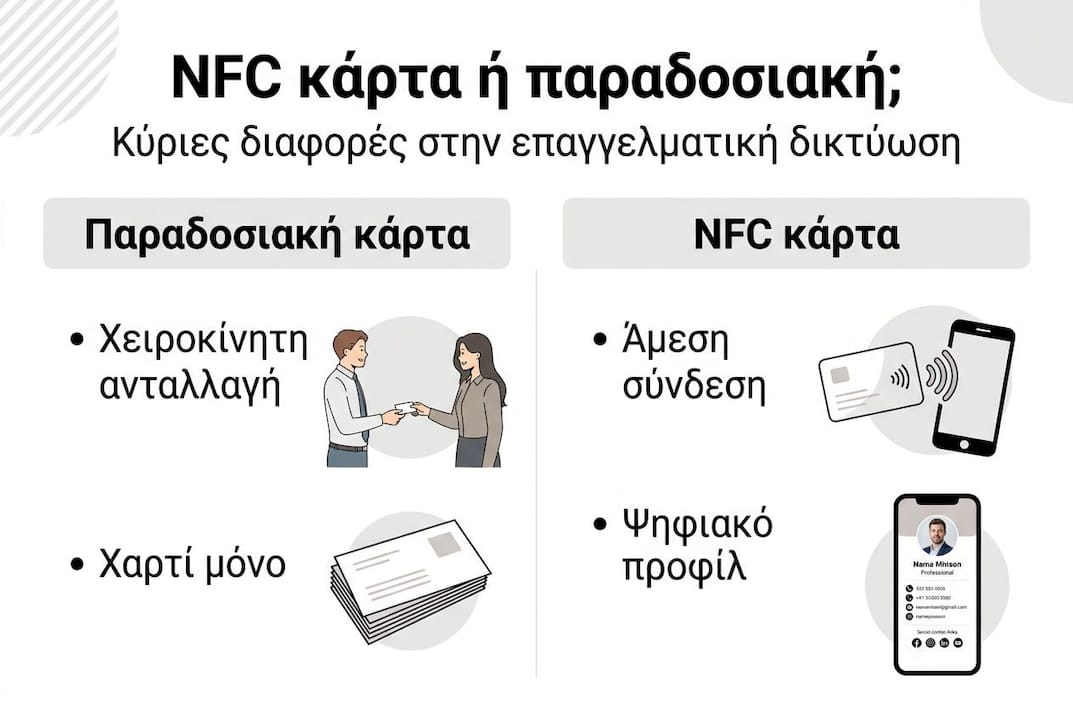
The most common chips for NFC business cards are NTAG213s, which open profiles with a single tap without an app. The NTAG213 offers 144 bytes of storage space, enough for a URL or a vCard. It is economical, widely compatible, and reliable for daily use.
To understand the practical difference, see the table below:
| Feature | Traditional card | NFC card |
|---|---|---|
| Information exchange | Manual | Automatic via tap |
| Updating details | New printing | Instant online |
| Cost per change | High | Zero |
| Impression on recipient | Ordinary | Modern, premium |
| Usage tracking | Impossible | Trackable analytics |
NFC offers an impressive result for in-person contacts, although its effectiveness depends on the compatibility of the recipient's device. This is something we will address below with the QR fallback solution.
The main advantages reported by professionals who have already adopted NFC cards:
- Instant transfer of contact details without typing
- Ability to update information without needing a new card
- Link to a digital profile that includes a portfolio, social media, and website
- Trackable analytics so you know how many times your card was scanned
- Reduced printing costs in the long run
If you want to learn more about the basics, see what an NFC card is and how it fits into modern networking. Additionally, the advantages of NFC in networking are analyzed thoroughly for those who want a deeper understanding.
Design and personalization of digital NFC cards
Now that we have understood the advantages of NFC as a technology, let's focus on how you can truly adapt it to your brand identity.

Personalization is what turns a simple NFC card into a branding tool. Having a chip is not enough. You need a design that reflects your corporate identity and a digital profile that gives a full picture of your brand.
Key personalization options include:
- Printing your logo and corporate colors on the card for instant recognition
- Material selection: PVC for an economical solution, metal for a premium feel
- Digital profile setup with all contact details, links, and portfolio
- CTA (Call to Action) definition: save contact, book an appointment, download a brochure
- Analytics activation to track scans and interaction
NTAG213 chips offer economy and sufficient storage space for a URL or vCard, making them an ideal choice for most professional applications. If you need more space, there are also NTAG215 and NTAG216 chips with larger capacity.
The table below compares the main chip options:
| Chip | Storage space | Cost | Use |
|---|---|---|---|
| NTAG213 | 144 bytes | Low | URL, vCard |
| NTAG215 | 504 bytes | Medium | Extended data |
| NTAG216 | 888 bytes | Higher | Multiple links |
The digital profile connected to the card is just as important as the card itself. A trackable landing page with a call-to-action increases ROI and interaction, allowing you to measure results and constantly improve your approach.
Your profile can include: contact details, links to LinkedIn, Instagram or website, work portfolio, contact save button, and a contact form. All of this can be updated online, without needing a new card.
Pro tip: Before ordering cards, prepare your digital profile first and test it on different devices. This ensures the recipient's experience is flawless from day one. To get started, see how to go about obtaining an NFC card step by step.
Combining NFC and QR for accessibility and reliability
Once we have configured our personalized NFC card, it is important to ensure that no potential professional contact is lost due to technological hurdles.
NFC does not work the same way on all devices. Older Android smartphones, some budget models, and certain iOS versions have limitations. Specifically, 15-22% of devices may not support NFC directly, which means that without an alternative solution, you lose one in five professional contacts.
Additionally, iOS devices lack full vCard support, so a fallback method is needed. This is where the combination of NFC and QR code on the same card comes in.
Key scenarios where a QR is proven necessary:
- Devices without an NFC reader (older models)
- iOS devices with NFC background reading limitations
- Areas with interference (e.g., metal surfaces near the card)
- Users who don't know how to use NFC
- Printed materials (brochures, posters) where NFC is not applicable
The solution is simple: a card with an NFC chip and a QR code leading to the same digital profile. The recipient uses whichever is easiest for them. The result is the same: they arrive at your profile, see your details, and can save you or get in touch.
Pro tip: Place the QR code in a visible spot on the back of the card with a brief instruction like “Scan to find me.” This eliminates any confusion for the recipient.
For cross-platform compatibility, ensure your digital profile loads quickly on mobile, is responsive, and does not require a login. Check out the reasons for an NFC card and the networking with NFC guide for practical implementation advice.
Advanced practices, mistakes, and challenges with NFC cards
Having ensured maximum accessibility, we must look at the most common mistakes so you can create a completely reliable and secure experience.
Many professionals buy NFC cards without checking basic parameters and end up with a product that doesn't meet their needs. The most common mistakes and how to avoid them:
- Choosing a cheap, non-certified chip: There is incompatibility with low-quality chips and a risk of skimming if there is no encryption. Always choose an NTAG chip from a reliable manufacturer.
- Committing to a subscription platform without checking terms: Subscription platforms may lock your data even after cancellation. Always read the terms before committing.
- Incomplete digital profile: If the profile doesn't have a clear CTA, the recipient doesn't know what to do after scanning.
- Lack of analytics: Without tracking, you cannot measure effectiveness and improve.
- Unupdated profile: If you change your phone number or email and don't update the profile, all the cards you have handed out will lead to incorrect information.
Security in NFC is not just a technical issue. It is also a matter of trust. A reliable chip with encryption and a platform with clear terms of use are the foundation for a brand that respects itself and its contacts.
From a technical point of view, before you buy NFC cards, check: the chip type, compatibility with iOS and Android, the ability to update the profile at no extra cost, and the existence of an analytics dashboard. To see how NFC compares to other options, check out NFC vs paper card and the comparison with traditional cards for an analytical assessment.
For maximum ROI, use the card in every in-person meeting, update the profile regularly, and monitor analytics to see which contacts interact the most.
Why NFC does not replace — but enhances — professional branding
Having seen the challenges and best practices, it is time to examine how NFC tools enrich, rather than replace, professional branding as a whole.
There is a misconception that NFC means "throwing away paper cards." This is not always true. For events, sales, and real estate, NFC provides clear added value, but the hybrid type (NFC and paper) covers all scenarios. A professional working in an international environment, where some partners may not have a smartphone, needs both options.
NFC adds premium value because it creates an experience that the recipient remembers. The psychology behind it is simple: when something works instantly and impressively, it is associated with the brand using it. The dynamic digital profile, updated in real time, reinforces this impression because it shows that the brand is alive and active. Check out branding best practices to apply this logic in practice.
The future of professional networking is interactive, trackable, and responsive. NFC is already here. The question is not if you will adopt it, but when.
Get ready for the next level of branding with an NFC card
In closing, let's see how you can take the next step now and implement what we discussed.
TagTouch offers NFC cards for every professional need. From economical PVC options to premium metal cards, every product is connected to a customizable digital profile and an analytics dashboard.
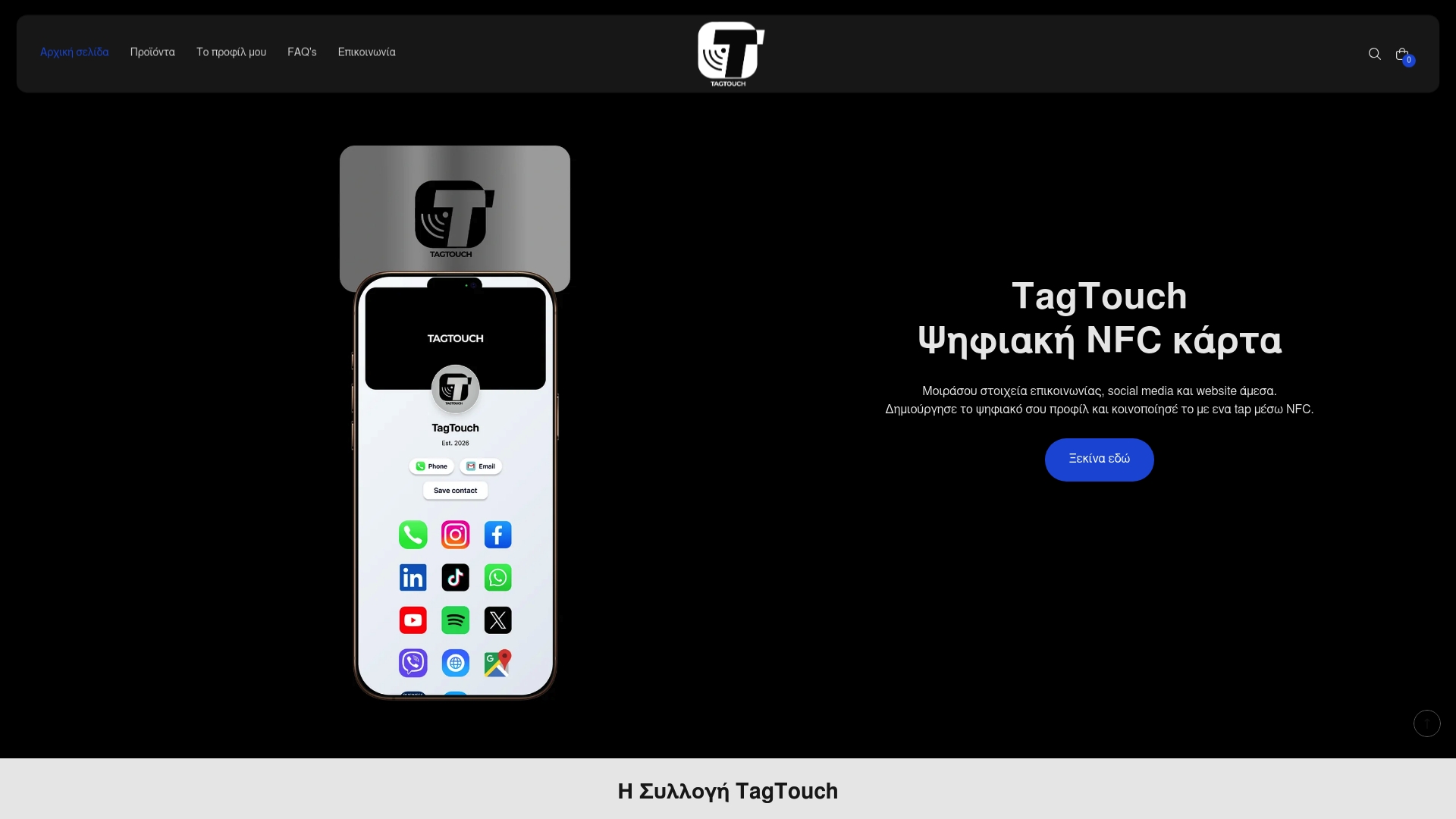
The Mirror NFC digital card offers a premium look for professionals who want to leave an impression. The White NFC PVC card is the economical choice for mass use. Both are activated instantly and support QR fallback. See all available TagTouch NFC solutions and choose the one that fits your brand.
Frequently Asked Questions
What advantages does NFC have over a traditional card?
An NFC card allows for instant information exchange and a connection to a customizable digital profile, while providing a wow-factor and immediacy in professional contacts that no paper card can offer.
Are there compatibility or security issues with NFC cards?
There are 15-22% of devices that may not always support NFC directly, which is why a QR fallback and choosing a reliable NTAG chip with encryption is recommended.
What should I pay attention to when choosing an NFC card?
Prefer an NTAG chip for reliability, the ability to have a trackable profile, and a hybrid solution with a QR for complete coverage of every scenario.
Is NFC worth it for every professional?
NFC is particularly suited for sales, events, and real estate, but every professional who wants an innovative presence and measurable results in networking can benefit immediately.