

TL;DR:
- 88% of traditional business cards end up in the trash within a week.
- NFC technology enables instant and secure data exchange with a single tap, reducing costs and environmental footprint.
- The combination of NFC and QR is the most effective networking strategy in 2026.
88% of traditional business cards end up in the trash within a week. This means that the majority of the money and time you invest in printed cards is wasted. NFC (Near Field Communication) technology is changing this picture. With a simple tap, your details are transferred instantly, without paper and without manual entry. This article explains why NFC is considered the most efficient choice for modern professionals and how to utilize it in practice.
Table of Contents
- What is NFC and how does it work in modern networking
- The key advantages of NFC in networking
- NFC, QR, and Bluetooth: Networking technology comparison
- Limitations and best practices for using NFC for professionals
- Our perspective: NFC is an indispensable tool, but not the only future
- Experience the future of networking with TagTouch NFC cards
- Frequently asked questions
Key Takeaways
| Point | Details |
|---|---|
| Instant and secure exchange | NFC enables instant contact transfer with one tap without apps. |
| Green and analytical solutions | NFC cards reduce waste and offer live statistics for every interaction. |
| Hybrid approach for everyone | The combination of NFC and QR ensures universal access and maximum networking success. |
| It's the future, not the only solution | NFC leads the new era of networking but remains part of a broader toolkit. |
What is NFC and how does it work in modern networking
Having understood the problems of traditional networking, let's see what makes the NFC solution so special.
NFC is a wireless communication technology that works at a distance of up to 4 centimeters. It uses electromagnetic fields to transfer data between two devices or between a card and a smartphone. This technology is already integrated into most modern mobile phones, both Android and iPhone.
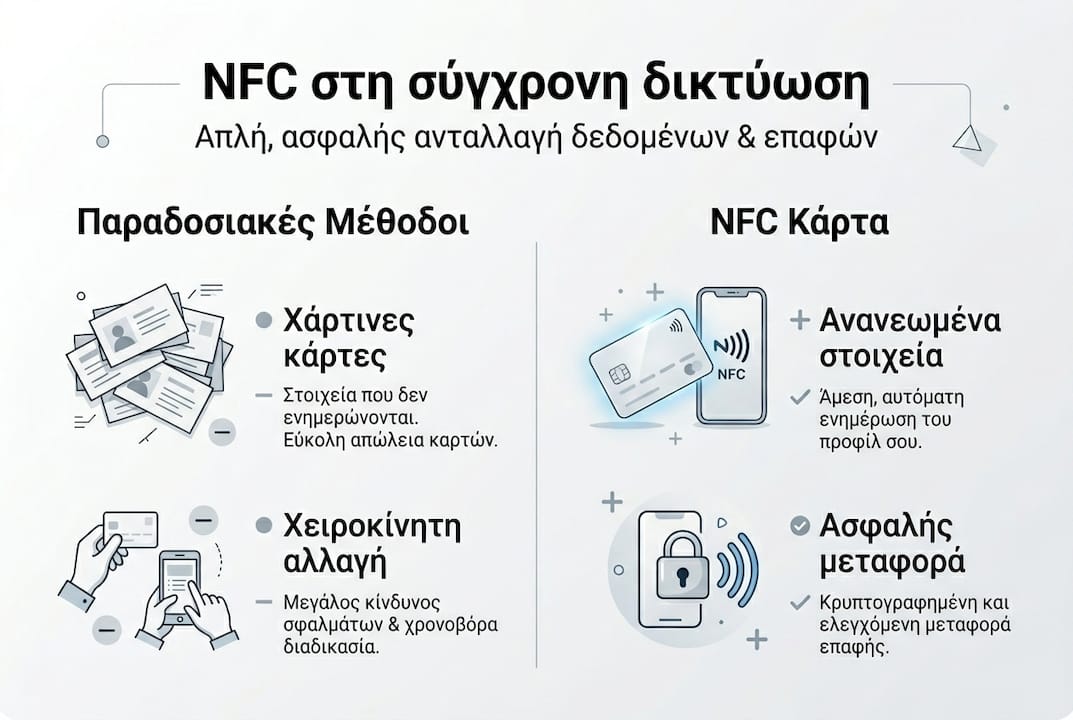
In practice, NFC card functionality is very simple. You bring your card close to the interlocutor's smartphone, and a link to your digital profile opens automatically. No app is needed, no Bluetooth connection is needed, no manual data entry is needed. NFC allows for instant exchange of contact details with a simple tap without apps.
Key features of NFC technology for professionals:
- Speed: Data transfer happens in fractions of a second.
- Simplicity: No app installation is required from the recipient.
- Security: Short range reduces the risk of data interception.
- Flexibility: The digital profile is updated without replacing the card.
- Compatibility: Works with the majority of modern smartphones.
In professional meetings, using an NFC card gives an immediate and clean impression. You aren't searching through your pockets for cards, and you don't worry about whether you have enough with you. In events with many participants, this speed makes a significant difference. You can exchange details with dozens of contacts in a few minutes.
The comparison between NFC and paper cards highlights another advantage: the paper card is static. If you change your phone, email, or job title, you have to print new cards. With NFC, you update your digital profile in seconds, and all previous contacts see the new details automatically.
Professional tip: Before any major event, check that your digital profile is updated and that the NFC card works correctly with different devices. This avoids unpleasant surprises at the moment it counts.
The key advantages of NFC in networking
With the technical details in mind, let's discover what makes NFC solutions truly superior in practice for professional networking.
The most immediate advantage is the ability to update details in real-time. If you change companies, add a new communication channel, or update your website, the NFC digital profile is updated instantly. No need for new printing, no need for new distribution. This significantly reduces costs over time.
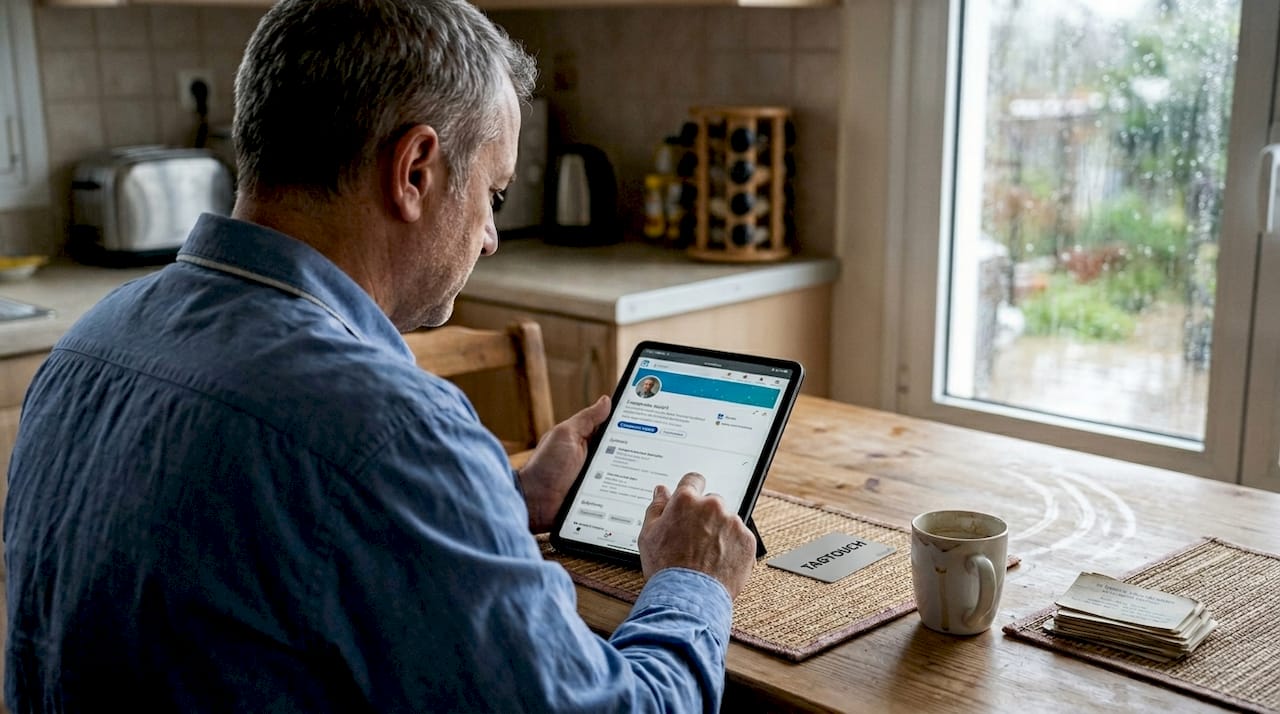
NFC digital profiles are easily updated and provide detailed statistics on how your contacts interact with your profile. This means you can see how many times your profile was opened, which links were clicked, and from which regions the visits originate. These are data that a paper card can never provide.
Key advantages compared to traditional cards:
- Zero reprint costs when your details change.
- Ecological footprint nearly zero compared to paper.
- CRM integration for automatic saving of new contacts.
- Professional image reflecting a modern mindset.
- Real-time analytics for measuring networking effectiveness.
| Feature | Paper Card | NFC Card |
|---|---|---|
| Updating details | New printing | Instant online |
| Annual cost | Recurring | One-time |
| Analytics | None | Full statistics |
| Ecological footprint | High | Minimal |
| Exchange speed | Manual | Instant with tap |
The NFC business card market is expected to reach billions of dollars by 2032, which reflects the rapid adoption by professionals globally. This growth is not accidental. Businesses recognize that digital networking is not just a trend, but a functional necessity.
Another important element is the ability to integrate with CRM tools like Salesforce or HubSpot. Every new contact that interacts with your NFC profile can be automatically logged into your customer management system. This eliminates manual data entry and reduces errors.
NFC, QR, and Bluetooth: Networking technology comparison
Knowing what NFC offers, let's compare it fairly with other digital networking solutions.
The three dominant technologies for digital contact exchange are NFC, QR codes, and Bluetooth. Each has different advantages and weaknesses that determine when it is the most appropriate choice.
NFC is faster and more secure than Bluetooth for data exchange over short distances. Bluetooth requires pairing between devices, which adds steps and time. NFC is direct: bring it close, transfer, done.
| Technology | Speed | Security | Convenience | Compatibility |
|---|---|---|---|---|
| NFC | Very high | High | Very easy | 80-90% of devices |
| QR Code | High | Medium | Easy | Almost 100% |
| Bluetooth | Medium | Medium | Medium | High |
The QR code has a significant advantage: universal compatibility. 82% prefer QR for universal compatibility, especially in hybrid or remote environments. This means that even devices without NFC can scan a QR code. However, QR requires a camera and usually an app or activating the camera, which adds an extra step.
The most effective networking strategy in 2026 is not to choose one technology, but to combine NFC and QR on one card for maximum coverage.
The advantages of each technology in real-world conditions:
- NFC: Ideal for physical meetings, quick exchange, high security.
- QR: Ideal for remote communication, presentations, printed material.
- Bluetooth: Useful for file transfer, less suitable for business cards.
For tips on NFC networking and practical advice, it is worth examining how NFC+QR hybrid cards cover every scenario. The guide for NFC networking provides step-by-step instructions for every professional sector.
Bluetooth remains useful for transferring files or connecting devices, but for exchanging business details, it is too slow and complex. The pairing process, searching for the device, and accepting the connection request make the process awkward in a professional environment.
Limitations and best practices for using NFC for professionals
After a fair representation of the market, it is critical to know the limits and implement practices that really work.
NFC is not perfect. There are limitations in device compatibility and minor malfunctions in NFC usage that you should know before relying exclusively on this technology. For example, some older iOS devices had limitations in reading NFC tags without an app. This has improved significantly since the iPhone 7, but it is not always guaranteed.
The most common limitations of NFC:
- Device compatibility: Older smartphones may not support NFC or have limited functionality.
- Phone cases: Some thick or metal cases may block the NFC signal.
- Device settings: NFC must be enabled in the device settings.
- Distance: Contact must be very close, which may seem awkward to some.
- Environmental interference: In spaces with strong electromagnetic fields, performance may decrease. -->
The best experience comes with using NFC+QR and browser-based profiles, so you cover every user case. This hybrid approach ensures that no interlocutor is left without access to your details, regardless of their device.
Hybrid NFC+QR solutions are becoming increasingly popular for exactly this reason. A card carrying both elements covers 100% of usage scenarios.
Best practices for maximum efficiency:
- Always check the card's function on different devices before major events.
- Keep your digital profile updated with current contact details.
- Use cards that also carry a QR code as an alternative.
- Inform the interlocutor how to use the card if they are not familiar.
- Leverage your profile's analytics to improve your networking strategy. -->
Professional tip: If you travel frequently to countries with different technology standards, choose a card that supports both NFC and QR. This ensures you will always be ready, regardless of the other person's device.
Our perspective: NFC is an indispensable tool, but not the only future
After analyzing capabilities and limitations, it's time for a more targeted, professional assessment.
NFC has clear and measurable value in modern professional networking. However, market experience shows that it mainly covers physical, face-to-face transactions. For remote or digital environments, QR remains more flexible. This is not an NFC weakness, but simply the reality of its use.
NFC applications for professionals show that the greatest value comes from combining technologies. A professional using NFC for physical meetings and QR for digital communications has full coverage. The prospects of NFC networking suggest that adoption will continue to grow, but always in combination with other digital solutions. The smart choice is not to replace all your tools with NFC, but to integrate it strategically into your workflow.
Experience the future of networking with TagTouch NFC cards
For those looking to move into action, we provide direct solutions. TagTouch offers flexible NFC business cards that fit every professional sector and need. From high-aesthetic metal cards to affordable PVC options, every product connects to a fully customizable digital profile.
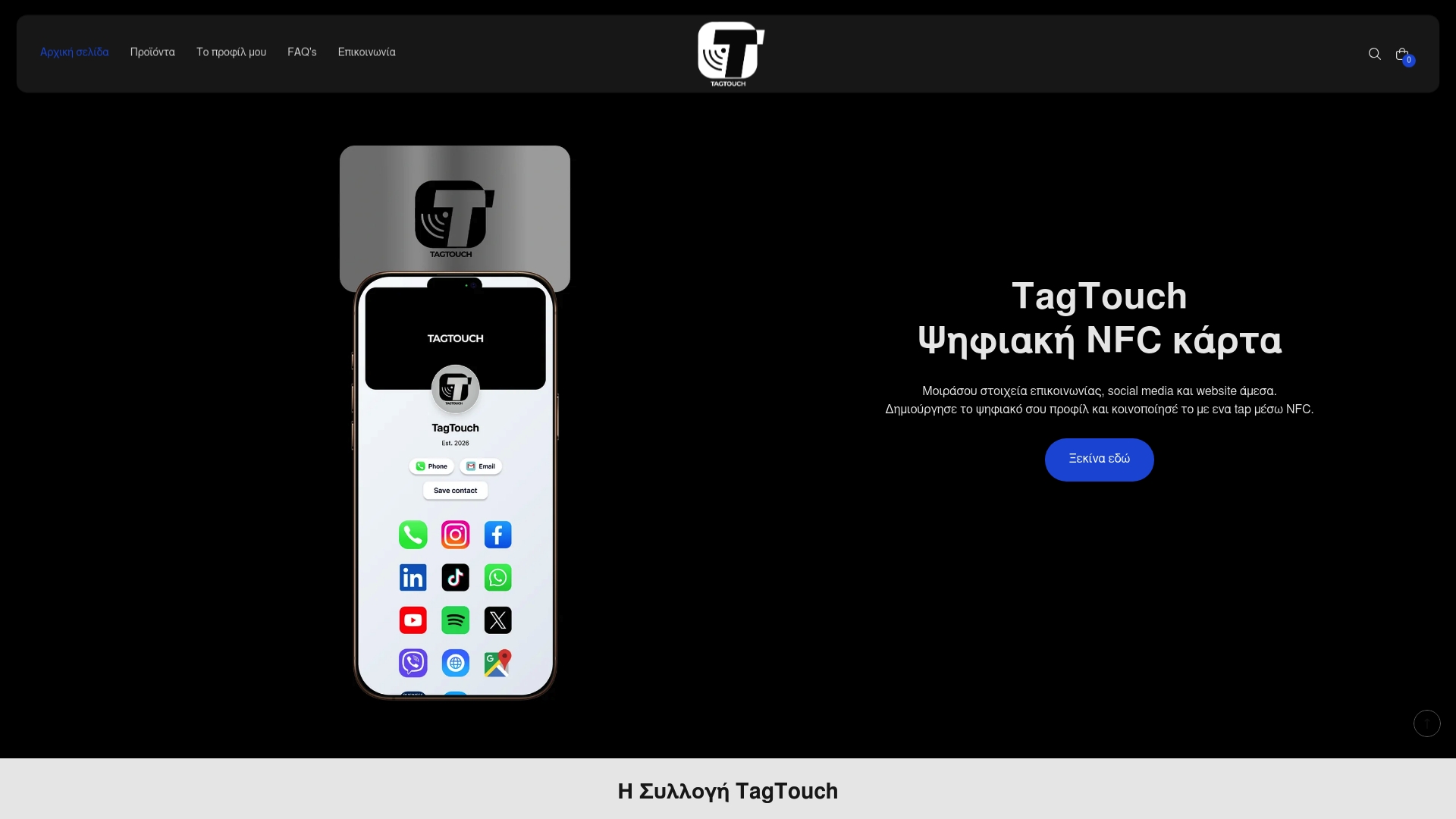
The Mirror NFC Card and the White NFC PVC Card are two of the most popular choices. Both support instant data exchange with a tap. Purchase and customization are done entirely online via our NFC digital solutions. Simple process, direct result.
Frequently asked questions
What is the difference in security between NFC and QR?
NFC is considered more secure due to encryption and short range, but caution is always needed regarding device settings. QR is more open and can be scanned from a distance without the owner's knowledge.
Do I need a special app to read an NFC card?
No. NFC allows for instant sharing without apps, as most smartphones with NFC read cards directly via the operating system.
Are all devices compatible with NFC cards?
Not all. NFC is supported by 80-90% of modern smartphones, so it is important to provide alternatives like QR codes for complete coverage.
Is NFC suitable for large business events?
NFC has high interaction at physical events, but hybrid use of NFC+QR is recommended for maximum usability and universal coverage of all participants.